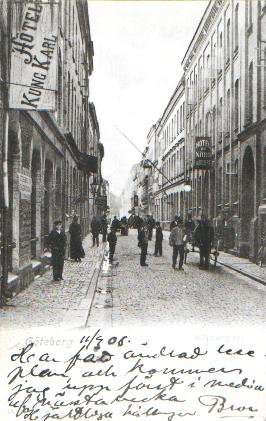
Göteborg, Sweden
The development of Göteborg as an emigrant center actually began in 1840 when
ship owner Thomas Wilson of Hull, England, began sailing the North Sea with
steamships. There was great profit awaiting those who, in addition to
passengers, could ship Swedish cattle and oats to a British market that craved
such goods. At the same time, Wilson attempted to capitalize on the mail traffic
to and from Göteborg, and to the city of Christiania (Oslo), Norway. Once his
son John West Wilson had established himself in Göteborg, business quickly grew
and, in 1850, the Wilson Line gained a permanent contract for mail forwarding
with both Swedish and Norwegian authorities who, in turn, guaranteed him certain
free harbor rights.
At this time, most of the emigrant traffic from northern Europe was funneled
through Liverpool,
Hamburg,
Bremen, and several other ports, to which passengers
would be carried indirectly from smaller port cities. John West Wilson realized
that his line could become the freight link between Sweden and Liverpool and,
thus, he began increasing passenger traffic by selling tickets that included
train travel from Hull to Liverpool and then by ship across the Atlantic. To
accomplish this, he signed agreements with approximately one dozen British
passenger lines in Liverpool. Wilson's "green ships," which once a week
dominated the view of the Göta River in Göteborg, thereby became known as
"America boats." Two steamships were started in partnered traffic so that boats
sailed from Göteborg and Hull at the same time. In England, the ships were
dubbed "Wilson's parrots" because their names all ended in "o," as in Rollo,
Hero, Airosto, and Romeo. Ships as large as Wilson's parrots were forced to
anchor out from the "America Pier," from which emigrants and freight were
ferried by barge or launch. It was not until the 1880s that the Göta River was
dredged to accommodate larger ships.
As early as 1852, a group of 250 Swedes sailed on Wilson's mail boats, which
from 1866 on, according to John West Wilson's own self-serving calculations,
dominated emigrant traffic from Göteborg. From 1872 to 1880, nearly all Swedish
emigrants traveled to Hull, and it is estimated that approximately eighty
percent of all Swedish emigrants who came through Göteborg during the decade of
the 1880s embarked on the "green ships."
According to advertisements in the 1870s, the Wilson Line ships departed "every
Friday evening following the arrival of the express train from Stockholm."
During the 1880s, the departures were changed to 1:00 p.m. The usual duration of
the trip was two days, so passengers arrived at Hull on Sunday afternoon. During
the intensive emigration of the 1880s, when some 325.000 emigrants departed,
extra trips were required to handle the large number of passengers; some weeks
during the spring saw as many as four large ships sailing from the Custom House
pier. In May, 1881, nearly 9.000 emigrants sailed on fourteen boats from
Göteborg, 2.650 of those on May 6 and 7. On April 14 of the following year,
Rollo steamed out with 1.000 passengers, Orlando with 853, and a competitor,
Marsden, with 934 on board - 2.783 emigrants in one day!
Such figures bear witness to the mass exodus that passed down Sillgatan during the heavy emigration months of springtime. Not surprisingly, Wilson's little fleet had to be continually expanded! Consequently, in April, 1881, the newly-built Romeo went into service with room for 1.000 third-class passengers who were offered "previously unknown" comforts. Romeo was apparently twice the size of Hero, which in 1866 could carry 550 passengers and was fitted with movable cattle stalls on the underdeck. The huge export of cattle plagued the emigrants for years with the foul smell, which old Swedish-Americans used to associate with the North Sea boats.
Sillgatan
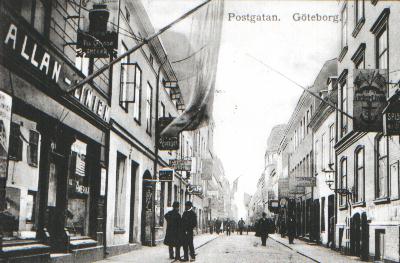
In the second half of the nineteenth century, the Nordstaden (North Side)
section of Göteborg was characterized by the ever-increasing emigrant flow,
especially Sillgatan (Herring Street) which ran between Central Station, the
terminus of the western mainline of the railroad, completed in 1862, and Custom
House Square with its "America Pier." This was also a good central location for
those arriving by boat on the inner city canals. This street, with its flavor of
Göteborg's earliest years, was first called Heringgatan, a name given by the
town's many Dutch and Germans with allusions to the active herring fishing of
the time. For those who wished to do business with emigrants, and especially the
emigrant agents, it was absolutely necessary to have an office on or near
Sillgatan.
The local agents, who often were well-respected men in their communities, had
all the brochures and timetables that the general agents produced and
distributed. They were also often backed by extensive advertising in the
newspapers. Agents' operations were constantly watched by both the authorities
and competitors; the slightest misstep could be reported, thereby costing the
general agent thousands of crowns in fines. In 1883, authorities forbade the use
of any emigrant propaganda produced outside of Sweden, a further incentive for
agents to abide by the lows. Such alert oversight led to a continual
self policing of the emigrant business which meant that emigrants could, as a
rule, trust the agents.
The emigrant regulations of 1869 appeared to leave few duties to the general
agents in Göteborg other than to fill out, in duplicate, the exit contracts and
emigrant registers and, at the stipulated time, submit them to the police who
would check off names as the emigrants boarded ship. In reality, however, the
general agent and his assistants had a long list of other, usually high-revenue
producing, activities. For example, to engender trust the agent would see to it
that emigrants were met at the train by a uniformed representative of the line.
Once the groups were gathered together, they were marched in single file to
various emigrant lodgings. Fr those particularly in danger of getting lost, the
agents would get a long rope and tell the innocents to hold on as long as the
rope moved. Due to rumors that the ticket price would be lower if one dealt with
the general agent in person, many emigrants arrived to Göteborg without their
prepayment receipt. Often there would be a tug-of-war in front of the Central
Station for these "unpropertied" emigrants, and it was not uncommon for agents
to get into fisticuffs over them. Occasionally a representative would resolutely
take an emigrant by the collar and drag him or her away to "the right" flock!
Accommodations cost twenty-five öre, "including bed with sheets and blankets,
coffee and rusks in the morning." Agents also concerned themselves with the
emigrants' leisure time. At one emigrant hotel, for example, an "American
language school" was arranged, and one could also study models of the ships that
awaited in Liverpool to cross the Atlantic with Swedes on board.
Hotel In Sillgatan