
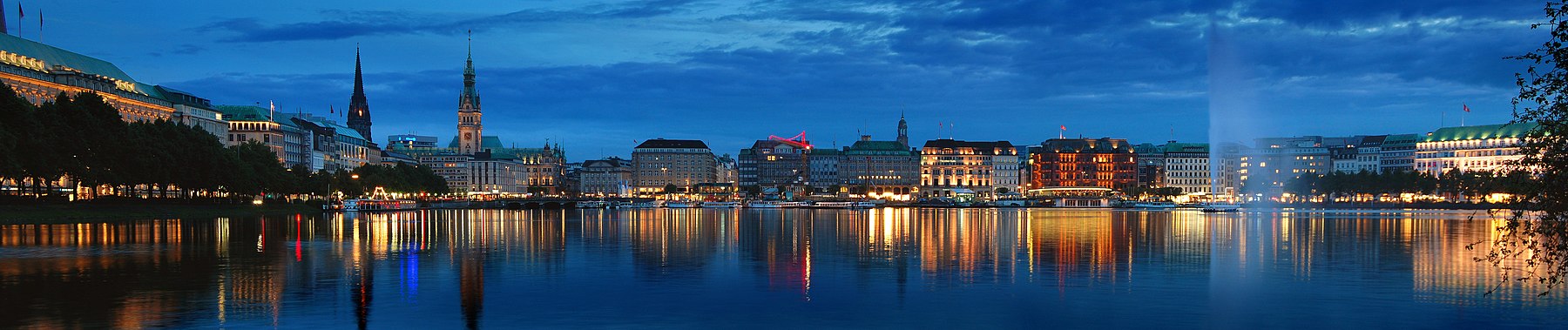
| Welcome to Hamburg, Germany. Hamburg was one of the many ports through which immigrants traveled on their way to American, Canada, and even Australia.In the 19th century emigration to the United States began. Hamburg was the transitional stop for emigrants from the Northern German coastal countries as well as from Eastern European countries. During the 19th century mass immigration to the west was occurring. In Germany, Bremen had a good reputation as a port of departure because its laws forced ship-owners to provide a basic minimum of space and food. Until 1850, Bremen was a more popular port than Hamburg. In 1847, the Hamburg American Parcel Joint-Stock Company (HAPAG) was founded in Hamburg, which put a number of new ships into service. Before this, conditions on the ships were not good; there was inadequate food and overcrowded rooms. As many as one-fifth of the passengers did not survive the crossing to America. To improve Hamburg's reputation as an emigration port, the Senate passed laws to protect emigrants and guaranteed sufficient food, space, and medical care on the journey. Conditions improved for emigrants in 1870 with the commission of new steamships. While still cramped, hygiene was much better than the old sailing ships. Starting in 1895, emigrants were segregated based on wealth. The experiences on the ship (and the immigration process into the United States) depended on which class of passengers an emigrant was a part of: first, second, or steerage. Hamburg became the most important emigration port in Germany by 1900. Between 1830 and 1914, more than four million people left Europe via Hamburg. By 1914, more than one million Eastern European Jews had emigrated to the United States through the port of Hamburg. To attract immigrants, the HAPAG set up shipping companies throughout Germany and neighboring countries to entice immigrants to come through the port of Hamburg. The improved conditions of the ships also improved the port's reputation. Clean and hygienic accommodations were built in 1900, called Auswandererhallen, to house the increasing emigrants. This attracted even more emigrants to the port of Hamburg. Previous to this, barracks were constructed to house the emigrants but the conditions were deplorable and disease spread quickly. In addition to clean housing, medical exams and disinfections were conducted to ensure that only healthy individuals left the port. |